Comparing the Fear of Difference in Waiting for the Barbarians through Disney Movies
- anndeek
- Nov 29, 2018
- 6 min read

Updated: Nov 30, 2018
An odd comparison, especially when one of the subject's demographics target young children. But, because those stories are the most familiar to us, I thought it’d be appropriate to use them as analogies.
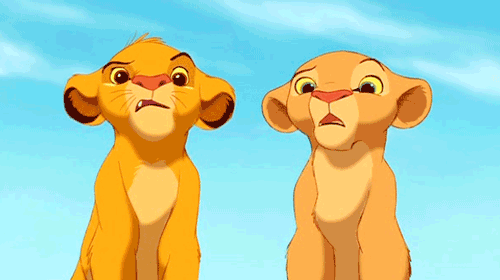
When Waiting for the Barbarians was first introduced to me, I recognized the importance of the symbolism of sight, the opposition between the two nations, and the fabricated construct in the connotation of the term barbarian. What stuck out to me the most was a topic that simply served to umbrella all of these sub-points: the fear of difference. The fear of the unknown, beyond the comfort of one’s own empire, forced the characters to question their values and beliefs. It forced the Magistrate to recollect himself, and to rediscover what he thought he had understood about these barbarians, as well as the authority that had come to essentially shadow over him. Even Colonel Joll, as cool and collected as the Magistrate had once laid him out to be, became so disoriented by the unpredictability of these constructed barbarians that he ordered them to be questioned and tortured until they presented him with the answers he desired to make himself feel safe, secure. This is where we can draw our inferences to our beloved Disney princesses, and compare the similarities of their situations.
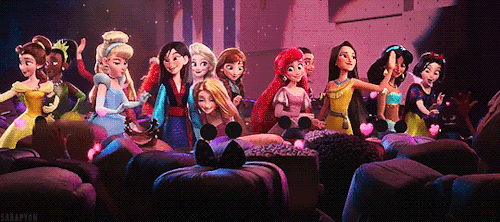
Pocahontas is arguably the most notable examples in this situation: based on a real historical figure, Pocahontas’s case shows the explicit differences between the European settlers and the Powhatan tribe. This is analogous to the authoritarian power of the Empire when it arrives and deems the people who inhabit the desert as barbarians. In both the following situations, the two worlds collide, and chaos promptly ensues. The Powhatan people, viewed as savages from the Europeans, were viewed as inferior because their customs and technology did not seem as advanced in comparison to the European hand. However, we must realize that many of these terms are up to interpretation, as these same words are social constructs. They were created to enable the understanding of something unknown by attempting to label it as something that would be easier to understand.
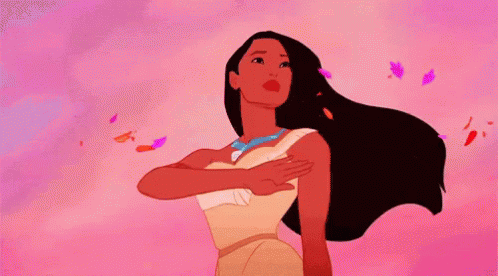
Another prominent example of fear of differences is shown in Disney’s The Little Mermaid. In fact, this theme was so prevalent in the movie that it became the main conflict of the story. Although we all accept that this story revolves around a great deal of fiction, the moral still stands: one nation fears another, because they are foreign and unpredictable. The merpeople see themselves as superior to humans, showing their disdain for any event that occurs above the shoreline. However, this scornful façade acts to mask their fear: simply put, the merfolk are unfamiliar with human antics. Because they are not predictable like merfolk, humans are deemed as barbaric, and essentially inferior, to the opposing nation. This is comparable to the lack of familiarity in the two groups in the novel. As stated before, because Colonel Joll is not familiar with the peoples of the desert, he deems them as barbarians—an unsophisticated people—to mask his fear of what he does not know.
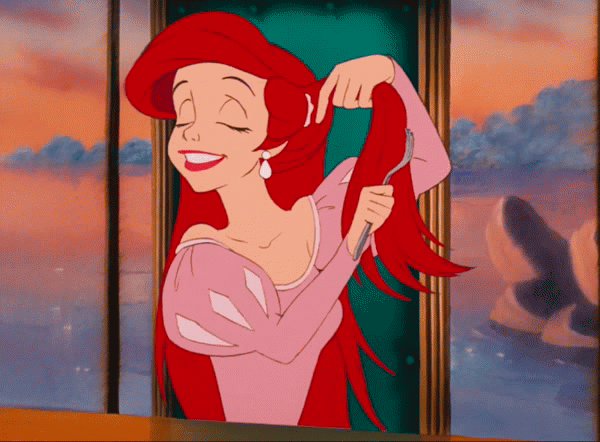
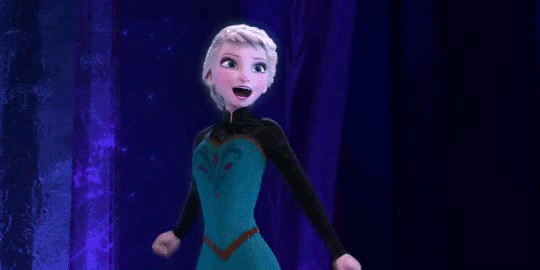
In addition, the Empire felt that there was a breach of safety, from the unfamiliarity of the desert people. Because one’s safety and power is on the line, it is reasonable to believe that the Empire created a false notion of how the desert peoples were to be envisioned to retain their power and authority. Here, we are able to draw from the Disney classic, Frozen, to understand the reactions of the Empire. Elsa’s image, once she’d revealed her then-uncontrollable magical ice abilities, changed from a withdrawn queen to a monster, with the ability to harm and destroy. Because no one else had the ability to understand her power, the town feared her and what she had the potential to be—a villain. From this unpredictability, she felt shunned from her own society because she was different: she simply had no one else to relate to, which led to the belief that she was a weapon, a method for destruction. This ultimately led to chaos, both in herself, as well as her kingdom. Similarly, the Empire’s fear of the ability to withhold the rumored attacks from these constructed barbarians were what led to turmoil in the novel. This unfamiliarity poses a threat to the status quo already present in these existing societies; oftentimes, as shown in both in the movie and in the novel, those threatened will do whatever it takes to stop it.
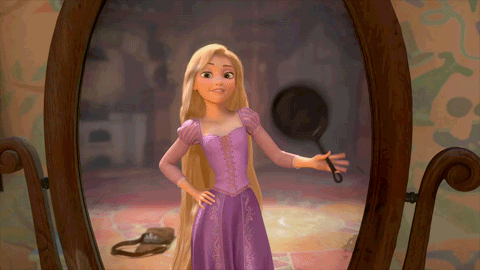
Disney's Tangled does a fantastic job at emphasizing the fear present in the unknown. Fed through the lies of Mother Gothel, Rapunzel is given preconceived notions of what the outside world is like. Without any contact with anyone but her chameleon Pascal, it is only inevitable that Rapunzel would develop a sort of bias to her surroundings and environment if they were unfamiliar to her. This is seen similarly through the tensions present in the two different nations in the novel. This is specifically seen through the perspective of the Empire, who envisions the desert peoples to be savage, and barbaric. Because they've had little exposure and contact with these peoples, even the slightest notion or possibility that the people may riot against the Empire strikes the nation with fear.
This final example shows a less obvious version of savagery. Although we expect to analyze how the Beast is viewed in Belle’s society in Beauty in the Beast, the concept will more or less overlap with what has already been analyzed above. Instead, we focus on Belle herself, in comparison to her village in the opening number of the movie. Belle poses a threat to the people in her village simply because she refuses to conform to the norms of her society. As someone with the aptitude and knowledge she has, she could’ve easily seen herself as more superior to her neighbors in the village, who live their lives as a daily routine. However, it’s significant to note that she is more or less shunned in her community; this is simply because she does not comply to the needs of the society that she presides in, and they fear her for that. Similarly, the Empire deems itself as more superior to who they deem as barbarians because the desert peoples are not willing to conform. The so-called barbarians have their own societies to pertain to, and because they riot against the Empire, deemed as the almighty authoritarian figure, the desert peoples are seen as barbaric and uncivilized. However, we—as the reader—are aware that these terms are only a social construct: they are created by the Empire because they do not understand the customs of other cultures. Essentially, the Empire fears that who they identify as barbarians may one day rise up and challenge the power the Empire thought had once belonged only to them.

To tie back into the aspects of the deemed savages in Waiting for the Barbarians, the Magistrate ability for him to look past the narrow-minded perspective of his own society, he is able to grasp the notion that those deemed as barbaric are not as wild and primitive as the Empire envisions them to be. In contrast, the colonel fears these people because they are not familiar to him; therefore, they pose a threat to his confidence in understanding himself as well as his position in authority within the Empire. He believes since that it is an endangerment to his power as the authoritative figure, so he must assert dominance to overpower this insecurity. This is similar to many of the characters who convey their distrust to the opposition in the following movies; they simply retaliate by attempting to assert dominance before pledging their lives for their nations and charging into the battlefield. Yet, in the midst of all this chaos, it is the mediator—the one who possesses the ability to communicate between these two worlds—who ultimately gets the benefit. They learn the harsh truth of these clashing worlds, but they turn out with the greatest scope of understanding in comparison to the other characters in the movie. Because this is so, it teaches us a valuable lesson: to view the world in a multitude of perspectives, and to understand that the fear of the unknown hinders our ability to essentially progress. That is a lesson that we all hope to learn for ourselves, as well.
Works Cited
J.M. Coetzee. Waiting for the Barbarians. New York: Penguin, 1982.
“Beauty and the Beast.” IMDb, IMDb.com, 22 Nov. 1991, www.imdb.com/title/tt0101414/?ref_=nv_sr_2.
“Frozen.” IMDb, IMDb.com, 20 Nov. 2013, www.imdb.com/title/tt2294629/?ref_=nv_sr_1.
“Pocahontas.” IMDb, IMDb.com, 23 June 1995, www.imdb.com/title/tt0114148/?ref_=nv_sr_1.
“Ralph Breaks the Internet.” IMDb, IMDb.com, 21 Nov. 2018, www.imdb.com/title/tt5848272/.
“Tangled.” IMDb, IMDb.com, 24 Nov. 2010, www.imdb.com/title/tt0398286/?ref_=nv_sr_1.
"The Lion King." IMDb. IMDb.com, 23 June 1994. Web. 29 Nov. 2018.
“The Little Mermaid.” IMDb, IMDb.com, 17 Nov. 1989, www.imdb.com/title/tt0097757/?ref_=nv_sr_2.


Comments